
Choosing an employee training course can feel like the obvious first step when a team needs to improve. But there’s an important question that should come before looking at courses: What skills are actually missing? Without a clear answer, organizations can end up investing in training that sounds useful but doesn’t address the problems employees are facing in their day-to-day work. A team might complete a communication course when the real challenge is management. Employees may receive advanced software training when they’re still struggling with the basics. In other cases, training gets assigned simply because it seems relevant to everyone, even though different roles have very different needs. This is where performing an employee skills gap analysis can help. A skills gap analysis compares the skills employees currently have with the skills they need to perform their roles effectively. For HR and L&D teams, that comparison can provide a much clearer starting point for deciding where training is necessary, who needs it, and what kind of learning would actually be useful.
Skill gap analyses don’t need to become a complicated company-wide project, either. Sometimes the most useful insights come from looking at performance patterns, speaking with managers and employees, reviewing business goals, and identifying where people repeatedly need additional support. Getting this initial step right can make everything that follows more focused. Instead of asking, “What training should we offer?” the conversation becomes, “Where is the gap, and what would help close it?”
That small change in thinking can lead to better training decisions and a much better chance that the time employees spend learning translates into something useful back at work.
What Does a Skills Gap Actually Look Like?
A skills gap isn’t always obvious. Sometimes it shows up in performance reports, but just as often it appears in the small frustrations that managers see every week. Maybe a team has access to Microsoft Excel, but only a few people know how to use anything beyond the basic functions. A newly promoted manager may know the business inside and out but struggle when it comes to giving feedback or handling a difficult conversation. Or a company may introduce AI tools and quickly realize that employees aren’t sure what information is safe to share with them. Those are very different situations, but they have something in common: there is a difference between what people can comfortably do and what their role now requires them to do. These kind of scenarios are essentially what an employee skills gap analysis is trying to uncover. For an L&D team, knowing that a gap exists is only the beginning. The more useful part is understanding where it comes from and whether training can realistically help.
Sometimes Training Isn’t the Answer
This part is easy to overlook. When something isn’t going well at work, training can become the default response. Sales are down? Training. A process isn’t being followed? Training. Employees aren’t using a new system correctly? More training. But people don’t always struggle because they lack knowledge. Think about an employee who already knows how to complete a process but has to search through several systems every time they need information. Giving that person another course won’t make the process faster. The problem is somewhere else. The same goes for unclear expectations. If employees have never been told what “good” performance looks like, it’s difficult to resolve that with learning alone.
On the other hand, there are situations where training makes a lot of sense. A manager who has never learned how to conduct a productive performance conversation may benefit from management training. An employee who regularly handles company data but doesn’t understand phishing or password security has a genuine knowledge gap that cybersecurity training can address.
That distinction can save an L&D team a lot of time.
Before asking, “Which course should we assign?” it is worth asking something simpler:
Is there actually a skill or knowledge gap here?
If the answer is no, the solution probably isn’t assigning another course.
Look at Where the Company Is Going, Not Just Where It Is Today
Skills gaps aren’t limited to things employees are struggling with right now. Sometimes people are doing their current jobs perfectly well, but the business is changing quickly around them. AI is a good example. A company might decide that employees should begin using generative AI for certain tasks. That doesn’t mean everyone suddenly needs advanced AI training. Someone working with sensitive information may first need to understand data privacy and responsible use, while another employee may need help writing useful prompts.
The gap depends on the person, the role, and what the organization expects them to do.The same thing happens when employees move into management, when companies adopt new software, or when teams take on responsibilities they didn’t have before.That’s why looking only at past performance can miss part of the picture. A useful skills-gap discussion should consider both what employees need today and what they are likely to need next. That gives L&D teams a much better starting point for deciding where training is worth the investment.
Finding the Gap Usually Starts With the Work Itself
You can learn quite a lot by looking at where people get stuck during a normal workday. Maybe the same Excel question keeps coming up. A manager regularly steps in to handle difficult customer conversations. New supervisors are comfortable assigning work but less comfortable giving feedback. Or employees have access to a new tool, but only a handful of people are actually using it. None of these automatically mean that a course is needed. They are simply places worth looking at more closely.
Managers will probably have some of the answers, but employees often see a different side of the problem. Someone may look slow at a particular task when, in reality, they were never shown the quickest way to do it. Another person may know exactly what to do but avoid a feature because they aren’t confident enough to use it without help.
This is where a simple conversation can be useful. Ask people which parts of their work they regularly have questions about. Ask managers what they find themselves explaining more than once. Look at recurring mistakes, customer feedback, support requests, or tasks that seem to take longer than they should.
For some skills, it also helps to see the work rather than ask about it. Most of us would probably say we’re “pretty good” at software we use every day. Give two people the same spreadsheet task, though, and you may find that one finishes it in five minutes while the other takes twenty. That tells you something a self-assessment probably wouldn’t. What you’re looking for isn’t a perfect score for every employee. You’re looking for repeated friction, places where a little more knowledge, practice, or confidence could genuinely make someone’s job easier.
Once those patterns start to show up, choosing training becomes a much more sensible conversation.
Not Every Gap Deserves the Same Attention
Once you start looking, you’ll probably find more areas for improvement than you expected. That doesn’t mean they all need to be assigned training courses. Some gaps have very little effect on the work people do. Others can affect productivity, customer experience, security, compliance, or someone’s ability to move into a new role. Those are usually the ones worth addressing first.
Imagine a team where several employees could benefit from learning a few advanced spreadsheet features, but the same company is also seeing managers struggle with difficult conversations and performance feedback. Both are legitimate development opportunities. The second one, however, may be having a much bigger effect on the team right now. Business plans matter here too. If the organization expects to introduce new technology, expand a department, or promote several people into management over the next six months, some skills become important before they turn into obvious problems.
This is where L&D has to make a judgment call. Training time and budgets aren’t unlimited, so the aim isn’t to close every possible gap. It’s to decide which ones are worth solving now.
Choose Training That Fits the Gap
Knowing that employees need development in “communication” isn’t quite enough to choose a course. Communication can mean presenting an idea clearly, writing better emails, listening to customers, giving feedback, handling conflict, or communicating as a manager. Sending everyone through the same general communication course may cover some of those things without really solving the original problem.
The more specific the gap becomes, the easier it is to find useful training. This is also where role differences matter. A new manager and an experienced department head may both need leadership development, but probably not the same learning experience. Someone who uses Excel occasionally has different needs from an employee who spends most of the day working with reports and data. Before assigning anything, look at what employees should be able to do differently after the training. If that’s difficult to explain, the learning objective may still be too broad. A course title can sound perfect and still be the wrong fit. The content, difficulty, format, and expected outcome matter much more.
Give People a Chance to Use What They Learn
Even well-chosen training information can disappear surprisingly quickly if employees never have a reason to use it. Someone can finish a course on Monday, understand it perfectly well, and then spend the next month doing work that never calls for the new skill. By the time they finally need it, much of what felt clear during the course may already be harder to recall.
That doesn’t necessarily mean the training failed. It may simply mean there was too much distance between learning something and using it.
This is worth considering when planning training around a skills gap. If a manager is learning how to give better feedback, for example, there should be opportunities to practice those conversations. If employees are developing Excel skills, they should be able to apply them to real spreadsheets. If a team is learning how to use AI tools responsibly, the guidance needs to connect with the situations they actually encounter at work. Small follow-ups can help too. A manager checking in, a short refresher, a discussion with the team, or another opportunity to practice can keep the learning from becoming something employees completed once and forgot about.
Training works better when it becomes part of the work rather than something that happens separately from it.
Check Whether Anything Actually Changed
Completion rates are useful. They tell you whether people took the training. They don’t necessarily tell you whether the original problem improved. A skills gap analysis isn’t really finished when a course gets assigned. The more meaningful question comes afterward: Did people become better able to do what the business needed them to do? If the reason for training was that managers were struggling to give useful feedback, check whether those conversations are getting better. If employees needed help using a particular tool, see whether they’re now completing the relevant tasks with less assistance. If repeated mistakes led to the training in the first place, look at whether those mistakes are happening less often.
The measure doesn’t have to be complicated. It just needs to connect back to the reason the training was chosen. Sometimes the result will also tell you that the first solution wasn’t enough. Employees may understand a concept but still need more practice. The course may have covered part of the problem but missed something important. Or you may discover that a lack of training wasn’t the main issue after all. That’s useful information.
Skills Gaps Change, So the Conversation Should Continue
A skills gap analysis shouldn’t become a document that gets completed once and forgotten. Jobs change too quickly for that.
A new software rollout can create a need that didn’t exist six months ago. Someone gets promoted and suddenly needs management skills they never needed as an individual contributor. A new security risk changes what employees need to know. AI tools are already changing tasks in roles that, not long ago, had very little to do with AI. That doesn’t mean companies need to constantly be assessing every employee.It does mean that conversations about skills should happen often enough that training isn’t always reacting to a problem after it has become obvious.
Managers can flag recurring challenges. Employees can talk about areas where they want more confidence. L&D teams can watch how roles and business priorities are changing. Together, those signals make it easier to spot a need before it becomes a bigger issue. For a growing company, that can be much more useful than waiting for the annual training plan to come around.
Better Training Starts With a Better Question
It’s tempting to begin employee development by asking, “What training should we offer?”
First, find out what people are having trouble doing, what they’ll be expected to do next, and whether additional knowledge or practice would actually help. Once you understand that, choosing the right learning becomes much easier. A thoughtful employee skills gap analysis can help L&D and HR teams spend their time where it has a real purpose. It can also make learning feel more relevant to employees because there is a clearer connection between the course assigned and the work they actually do. You don’t need to eliminate every gap.You need to understand which ones matter, decide where learning can help, and give people the chance to put that learning to work.
Frequently Asked Questions
What is an employee skills gap analysis?
An employee skills gap analysis looks at the difference between the skills employees currently have and the skills they need for their roles or for future business needs. Organizations can use that information to decide where training or other support may be useful.
How do you identify skills gaps in employees?
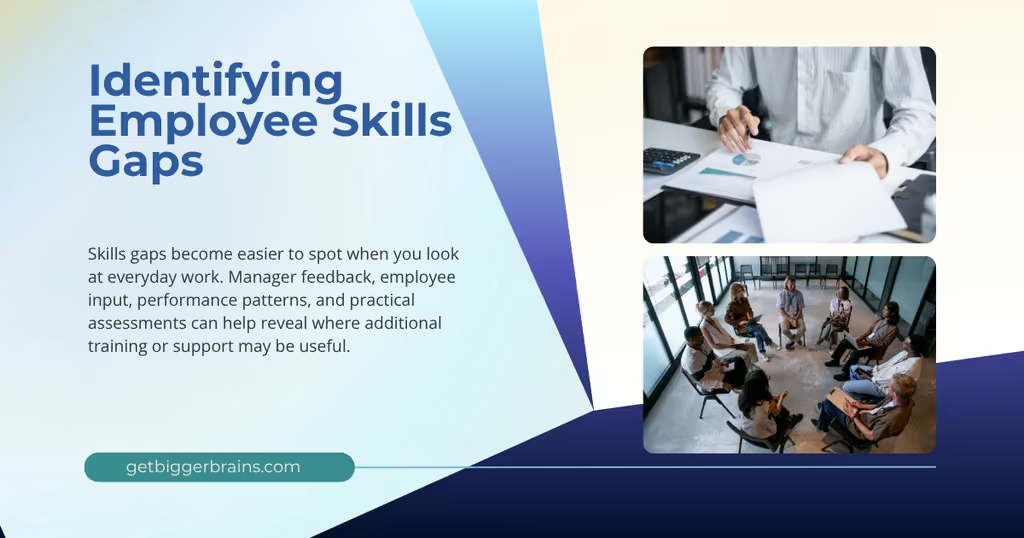
Look for patterns in everyday work. Manager observations, employee conversations, performance information, recurring mistakes, customer feedback, practical assessments, and upcoming changes in job responsibilities can all reveal areas where employees may need additional knowledge or practice.
Is a skills gap the same as a training need?
Not always. An employee may struggle because of an unclear process, missing resources, unrealistic workload, or another workplace issue rather than a lack of skill. It’s worth understanding the cause of a struggle before deciding that training is the solution.
How often should a company review employee skills gaps?
There isn’t one schedule that works for every organization. It makes sense to revisit skills when roles change, new technology is introduced, employees move into new positions, business priorities shift, or managers begin noticing recurring performance issues.
What should a company do after identifying a skills gap?
First decide whether training is actually the right response. If it is, define the specific skill that needs improvement, choose learning that matches the employee’s role and current ability, provide opportunities to use the skill, and later check whether performance has changed.
Can online training help close employee skills gaps?
It can, particularly when the training closely matches the skill employees need and gives them knowledge they can apply in their work. The format alone isn’t what makes training effective; relevance, appropriate difficulty, practice, and follow-up all matter.


