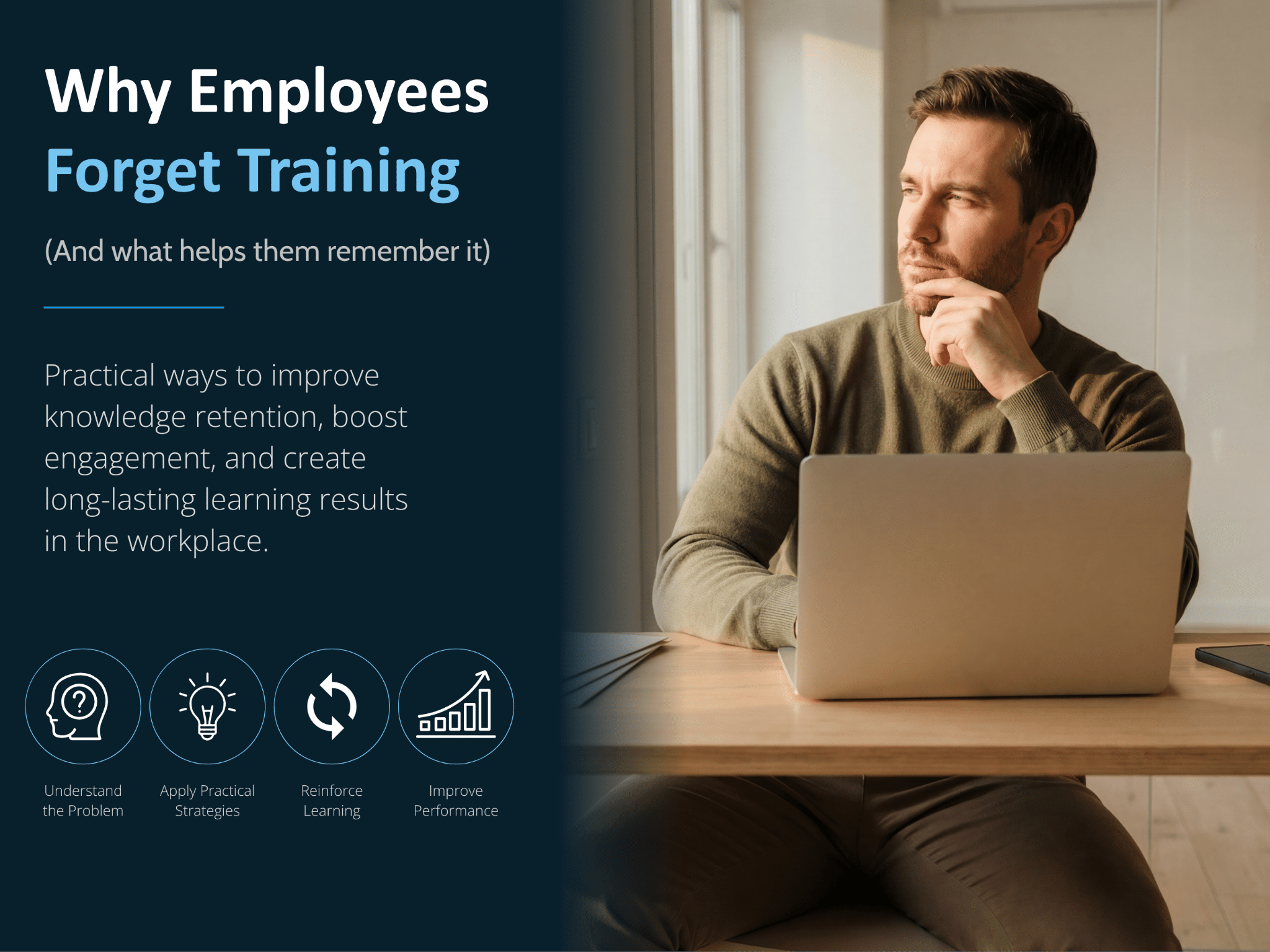
Have you ever invested in employee training, only to find that a few weeks later everyone has gone back to doing things the same way they always did?
It’s a frustrating situation, and it’s more common than many organizations realize. Companies spend time and money developing their teams, yet the expected improvements in productivity, communication, or workplace performance never seem to last. The assumption is often that the training wasn’t good enough or that employees simply weren’t interested.
In reality, neither is usually the problem.
People don’t forget because they don’t care. They forget because information that isn’t used regularly fades surprisingly quickly. Even the best training course won’t create lasting results if employees don’t have opportunities to apply what they’ve learned in their day-to-day work.
The good news is that organizations can change this. By understanding why knowledge fades and adopting a more practical approach to workplace learning, businesses can help employees remember more, apply new skills with confidence, and continue growing long after a course has finished.
Learning Doesn’t End When the Course Does
One of the biggest misconceptions about workplace training is that learning happens only while someone is sitting in front of a course or attending a workshop.
In reality, that’s only the beginning.
Real learning takes place when employees return to work and begin using their new knowledge in real situations. If they immediately start applying new skills, the information becomes familiar and gradually turns into a habit. If they don’t, it’s easy for the learning to fade as daily responsibilities take over.
Think about learning to drive a car. Reading the rules of the road is important, but confidence only comes from spending time behind the wheel. Workplace learning works in much the same way. Employees need opportunities to practise, make mistakes, and improve before new skills become second nature.
Organizations that recognise this difference often see much stronger results because they view training as an ongoing process rather than a one-time event.
Too Much Information Can Work Against Learning
It’s understandable to want employees to learn as much as possible, especially when introducing new software, processes, or company initiatives. However, trying to cover everything in one session often has the opposite effect.
After an hour or two of continuous information, most people begin to lose focus. By the following week, only a small portion of that information is likely to be remembered.
This is why shorter, focused learning experiences have become increasingly popular in modern workplaces. Instead of asking employees to absorb dozens of new ideas at once, organizations are breaking learning into smaller lessons that concentrate on one topic at a time.
For example, rather than teaching every Microsoft Excel feature in a single afternoon, employees may spend a few minutes learning formulas one day, charts another day, and PivotTables when they actually need them. The learning feels more manageable, and employees are far more likely to remember what they’ve learned because it relates directly to the work they’re doing.
Sometimes less really does lead to more.
Relevance Makes Learning Stick
Most employees genuinely want to improve. What they don’t enjoy is training that feels disconnected from their everyday responsibilities.
Imagine asking someone in customer service to spend hours learning advanced spreadsheet functions they may never use, while they still struggle with communication challenges they face every day. It’s easy to understand why that training would quickly be forgotten.
People naturally remember information that helps them solve immediate problems.
That’s why successful organizations begin by identifying the skills employees actually need instead of selecting courses simply because they’re available. A project manager may benefit from stronger leadership and communication skills, while someone working with data may gain far more value from improving Excel or reporting techniques.
When employees can immediately connect learning to their daily work, they’re much more likely to stay engaged and continue using those skills long after the course is complete.
Managers Play a Bigger Role Than They Realize
Many organizations view training as the responsibility of the learning department or HR team. While those teams play an important role, managers often have the biggest influence on whether learning continues after a course has finished.
A simple conversation during a weekly check-in can make a significant difference.
Instead of asking whether an employee completed a course, a manager might ask what new idea they’ve already started using or what challenge they’re hoping to solve with their new knowledge. Those discussions encourage employees to think about applying what they’ve learned rather than simply completing another training requirement.
Recognition also matters. When managers notice employees using new skills and acknowledge those improvements, learning becomes something employees value instead of something they simply finish.
Creating that supportive environment doesn’t require complicated systems. It simply requires leaders who are interested in helping their teams continue developing.
Continuous Learning Creates Better Results Than Occasional Training
Some organizations schedule one or two major training events each year and expect them to support employee development for the next twelve months.
Unfortunately, workplace learning rarely works that way.
Business priorities change. Technology evolves. New tools appear. Customer expectations shift.
Employees need opportunities to keep learning as those changes happen rather than waiting for the next scheduled training event.
Organizations that encourage continuous learning often find that employees become more confident trying new ideas because learning becomes a normal part of the working day instead of a special event.
Even spending fifteen or twenty minutes each week developing a new skill can have a surprisingly positive effect over time. Those small improvements gradually build stronger teams that are better prepared to adapt to change and solve new challenges.
Why Online Learning Makes It Easier to Remember New Skills
Over the last few years, the way people learn at work has changed considerably. Traditional classroom sessions still have their place, but many organizations are discovering that online learning offers something equally valuable—flexibility.
Employees no longer have to step away from work for an entire day to develop new skills. Instead, they can learn when it fits their schedule, revisit lessons whenever they need a refresher, and move at a pace that feels comfortable.
That flexibility has another important advantage. When employees forget part of a topic, they don’t have to wait months for another workshop. They can simply revisit the lesson, refresh their knowledge, and continue applying it to their work. This ongoing access helps reinforce learning over time instead of treating training as a one-time event.
Online learning also makes it easier for organizations to provide consistent development opportunities across different departments and locations. Whether employees work in the office, remotely, or in a hybrid environment, everyone has access to the same learning experience.
Building a Workplace Where Learning Becomes a Habit
The organizations that see the greatest return from employee training usually have one thing in common—they don’t treat learning as a separate activity.
Instead, learning becomes part of the company’s culture.
Employees are encouraged to ask questions, explore new ideas, and continue developing their skills throughout the year. Managers regularly discuss professional development during one-on-one meetings, and teams openly share knowledge with one another after completing courses or learning something new.
This kind of environment removes much of the pressure often associated with workplace training. Employees stop worrying about passing assessments or completing mandatory courses and instead begin focusing on improving their own performance.
Over time, those small learning habits create noticeable changes. Teams become more confident, collaboration improves, and employees are often more willing to take on new responsibilities because learning no longer feels unfamiliar.
Creating this culture doesn’t require expensive programs or complicated systems. It simply requires leaders who consistently demonstrate that learning is valued and supported.
Small Changes Can Lead to Better Learning Results
Improving knowledge retention doesn’t always require a complete redesign of your training strategy. In many cases, a few simple adjustments can make a significant difference.
Start by giving employees opportunities to apply new skills as soon as possible after completing a course. Practical experience is one of the strongest ways to reinforce learning.
Regular follow-up conversations also help. Instead of asking employees whether they completed training, ask what they’ve already started using in their daily work or what challenges they’re still facing. These discussions encourage reflection and make learning feel more relevant.
Another helpful approach is to continue introducing learning throughout the year rather than concentrating everything into a single training event. Even short learning sessions can reinforce existing knowledge while introducing new ideas at a pace that’s easier to remember.
Finally, remember that different employees learn differently. Some prefer structured courses, while others learn more effectively through short videos, practical demonstrations, or hands-on experience. Providing a variety of learning options gives everyone a better opportunity to succeed.
Investing in Learning Is Really Investing in People
Organizations often measure the success of training by looking at course completion rates or certificates earned. While those numbers can be useful, they don’t tell the full story.
The real value of learning appears in everyday work.
It shows when employees solve problems more confidently, communicate more effectively with colleagues, adapt quickly to new technology, or take the initiative to improve the way they work. These are the changes that strengthen teams and help businesses continue growing.
Helping employees remember what they learn isn’t about making training longer or more complicated. It’s about making learning practical, relevant, and continuous.
When employees understand why they’re learning something, have opportunities to apply it immediately, and receive ongoing support from their managers, they’re far more likely to retain that knowledge and use it to make a meaningful difference.
Training should never be viewed as something employees complete and forget. The most successful organizations understand that learning is an ongoing journey, and every new skill employees develop contributes to a stronger, more capable workplace.
Frequently Asked Questions
Why do employees forget training so quickly?
Employees often forget training when they don’t have opportunities to apply what they’ve learned soon after completing a course. Regular practice and ongoing reinforcement help improve knowledge retention.
How can organizations improve employee learning retention?
Organizations can improve retention by providing practical training, encouraging employees to use new skills immediately, offering regular refreshers, and making learning part of everyday work rather than a one-time event.
Is online learning effective for employee training?
Yes. Online learning gives employees the flexibility to learn at their own pace, revisit lessons whenever needed, and continue developing their skills without disrupting their daily responsibilities.
Why is continuous learning important in the workplace?
Continuous learning helps employees stay current with changing technology, improve workplace performance, and build the confidence needed to adapt to new challenges throughout their careers.
What makes workplace training successful?
Successful workplace training is relevant to employees’ roles, provides practical skills they can use immediately, and is supported by managers who encourage continuous learning and development.